You’re scrolling through editing service websites at midnight. Your inbox is full of wedding photos waiting to be edited. Your delivery deadline is in three days. And you’re starting to wonder: Should I really be doing all this editing myself?
If you’ve asked yourself this question, you’re not alone. Thousands of wedding photographers face this same dilemma every season. The photos are beautiful. The editing is exhausting. And somewhere along the way, many photographers come to the same realization: finding the right wedding photo editing service might be the best business decision they make.
But here’s the challenge: not all wedding photo editing services are created equal. Some deliver exceptional results in 24 hours. Others deliver mediocre results in 30 days. Some cost $2 per image. Others cost $20. Some understand your style perfectly. Others treat your photos like an assembly line.
So how do you choose? How do you find a wedding photo editing service that’s right for YOUR photography business, YOUR clients, and YOUR budget?
This guide will answer those questions.
What is a Wedding Photo Editing Service?
Before we talk about choosing one, let’s define what a wedding photo editing service actually is.
A wedding photo editing service is a team of professional
editors who specialize in processing wedding photos according
to your specific style and preferences. If you’re new to
outsourcing, read our guide on professional photo editing services for wedding photographers for a
complete overview.
Instead of you spending 30-40 hours editing each wedding, you upload your raw images to a professional editing service, they process them according to your specifications, and you download the finished gallery in 24-36 hours.
That’s the basic concept. But there’s more to it than that.
A true wedding photo editing service isn’t just about technical processing. It’s about understanding your vision. It’s about maintaining consistency across 2,000+ images. It’s about respecting your unique style while enhancing the beauty of the original photographs. It’s about communication, flexibility, and delivering work that makes you proud to send to your clients.
When you choose a wedding photo editing service, you’re not hiring a tool. You’re hiring a partner.
The 5 Must-Have Features of a Professional Wedding Photo Editing Service
Not all wedding photo editing services offer the same features. Some are better than others. Here are the five features you absolutely need when choosing a wedding photo editing service.
1. Fast, Guaranteed Turnaround Time
The fastest wedding photo editing service in the world is useless if they deliver photos three weeks late.
You need a wedding photo editing service that guarantees turnaround time. Most professional services promise 24-36 hours. Some promise 48 hours. Whatever the promise, it should be guaranteed — not “hopefully” or “usually,” but guaranteed.
Why does this matter? Because your clients are waiting. Because you have deadlines. Because a professional wedding photo editing service that respects your business will back up their promises.
2. Consistent, Professional Quality
Imagine opening your edited gallery and noticing:
- The first 50 images look beautiful
- The middle 100 images are decent
- The last 200 images look rushed
This happens when editors are fatigued. This happens when quality standards slip. This doesn’t happen with a professional wedding photo editing service.
A professional editing service maintains the same quality
standards from image #1 to image #2,000. Learn more about
what professional wedding photo editing actually looks like
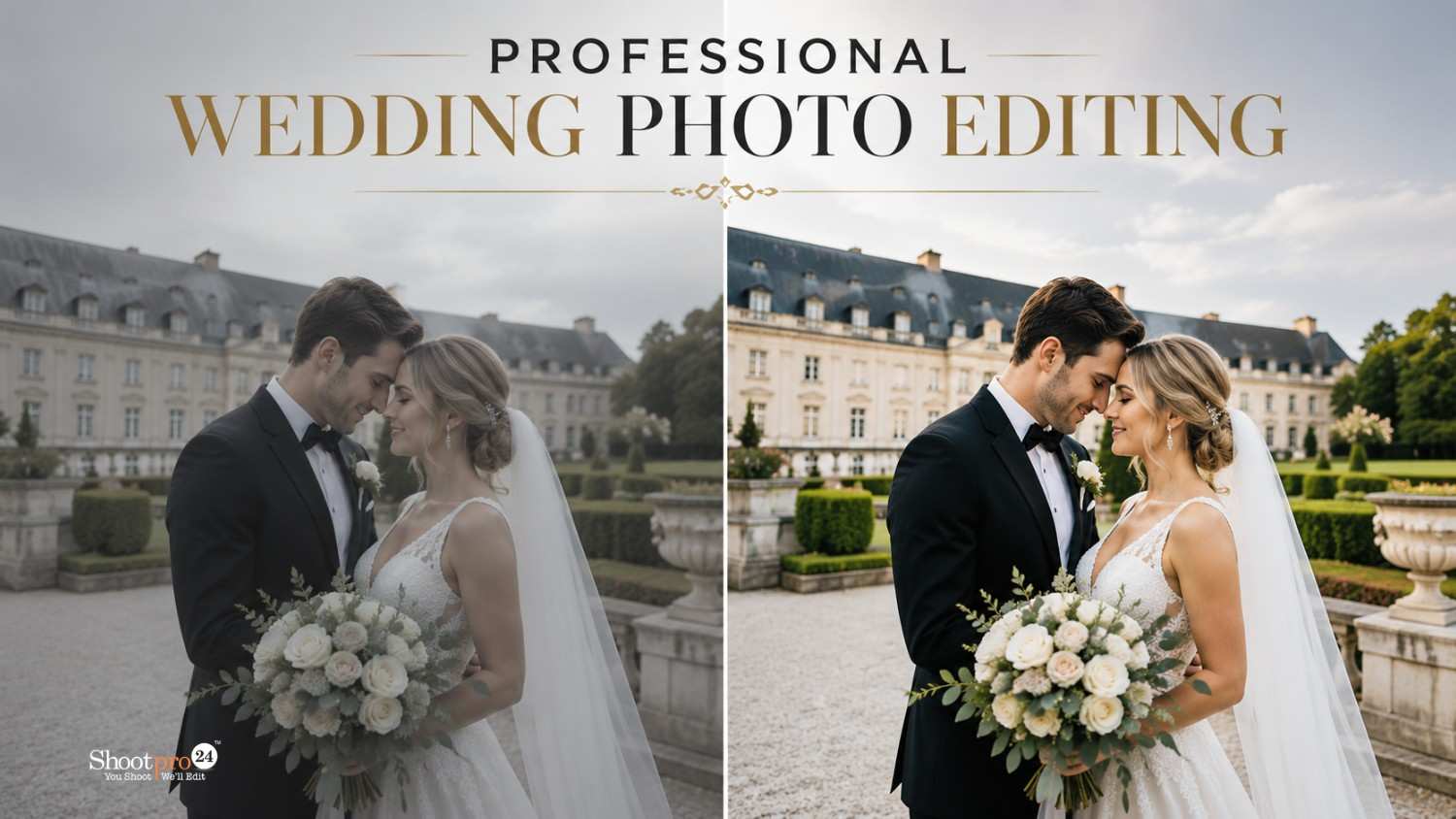
and the standards you should expect. Every skin tone is retouched. Every color is graded. Every detail is considered. Consistency is the hallmark of professional editing.
3. Flexible Workflow Integration
You have your own workflow. You use specific software. You have preferred file formats. You work a certain way, and you don’t want to change.
A good wedding photo editing service works WITH your workflow, not against it. They accept files however you want to send them — Dropbox, FTP, their own secure platform, USB drive, whatever. They deliver in your preferred format. They respect how you work.
4. Unlimited Revisions Until You’re Happy
What if you get your edited gallery back and something doesn’t match your style? What if the skin tones are slightly different from what you expected? What if you want adjustments?
A professional wedding photo editing service offers unlimited revisions. Not “two rounds of revisions.” Not “limited changes.” Unlimited. They don’t consider the job done until YOU are completely satisfied.
5. Transparent, Simple Pricing
Hidden fees are the worst. You think you’re paying $0.50 per image, then you get an invoice for rush fees, platform fees, revision fees, and suddenly you’re paying double.
A professional wedding photo editing service has transparent pricing. You know exactly what you’re paying before you upload a single photo. There are no surprise fees. No hidden charges. Just honest, straightforward pricing.
How Wedding Photo Editing Services Compare to DIY
Let’s talk honestly about the comparison between using a wedding photo editing service versus editing everything yourself.
Time Investment
When you edit your own wedding photos, you’re looking at
30-40 hours per wedding minimum. That’s why many photographers choose to outsource wedding photo editing — it saves time and improves quality.
During peak season (May through October), that’s 60-120 hours of editing per month, on top of shooting, client meetings, marketing, and everything else.
When you use a wedding photo editing service, you spend 30 minutes uploading photos and 30 minutes downloading the final gallery. That’s one hour instead of 40 hours. You’ve just freed up 39 hours per month.
What could you do with 39 extra hours per month? Shoot more weddings? Spend time with your family? Actually sleep? Build your business?
Quality Consistency
When you’re editing your own photos after a full day of shooting, you’re tired. Your judgment is impaired. You might crush the colors on the first 50 images, then miss details on images 500-700 because you’re exhausted.
A professional wedding photo editing service has fresh eyes on every image. No fatigue. No shortcuts. Just consistent, professional quality. Read more about why professional editing matters in this article.
Cost Analysis
This surprises many photographers: hiring a professional wedding photo editing service is often cheaper than editing yourself.
Here’s why: Your time has value. If you charge $3,000 for a wedding and you spend 40 hours editing, that’s $75 per hour of your time dedicated just to editing. A professional editing service might charge $200-400 per wedding. Suddenly, outsourcing saves you money AND time.
What to Look For When Choosing a Wedding Photo Editing Service
You’ve decided that a wedding photo editing service makes sense for your business. Now how do you choose?
Look at Their Portfolio
Don’t just look at their best shots. Ask to see a full gallery. Scroll through 100+ images. Do they maintain consistency? Does the editing style match what you want? Can you see their color grading philosophy? Learn more about professional photo editing standards to understand what to look for.
Do they respect the photographer’s original composition?
Check Their Turnaround Time
Does the service promise 24 hours, 36 hours, or 48 hours? Can they handle rush requests? What happens if you need photos faster? A professional wedding photo editing service should be transparent about timing.
Understand Their Process
How do you upload files? How do you communicate feedback? How do they handle revisions? Do they use a secure platform? Do they respect your workflow? The process should feel professional and smooth.
Review Their Pricing Structure
Is it per-image, per-wedding, or tiered? Are there volume discounts? Do they offer package deals? Is pricing transparent with no hidden fees? Can you afford to use them consistently?
Read Client Reviews
What do other photographers say? Do they mention reliability? Quality? Communication? Professionalism? Client reviews are honest feedback from people just like you.
Common Mistakes When Selecting a Wedding Photo Editing Service
Many photographers make mistakes when choosing a wedding photo editing service. Here’s what to avoid.
Many photographers make mistakes when choosing a wedding photo editing service. Here’s what to avoid. For more insights on
choosing vendors, check out this resource on vendor selection.
Mistake #1: Choosing Based Solely on Price
The cheapest wedding photo editing service is usually cheap for a reason. You get what you pay for. Paying $0.10 per image might save money short-term, but mediocre quality will damage your reputation long-term.
Mistake #2: Ignoring Turnaround Time Guarantees
If a service says “usually 36 hours” but can’t guarantee it, you’re taking a risk. What happens when you need the photos in 24 hours for an album deadline? Choose a service that guarantees their turnaround.
Mistake #3: Not Checking Communication
If you send a revision request and get no response for three days, that’s a problem. A professional wedding photo editing service communicates clearly and quickly.
Mistake #4: Overlooking the Revision Policy
“Two revisions only” is not professional. You need unlimited revisions. Period.
Mistake #5: Skipping the Test Wedding
Never commit to a full season of weddings with a new service without testing them first. Send one wedding, review the results, provide feedback, and see how they respond. Then decide if they’re the right fit.
How ShootPro24 Delivers Excellence in Wedding Photo Editing Services
You might be wondering: what makes a truly professional wedding photo editing service?
ShootPro24 has been delivering professional wedding photo editing services to photographers across the United States for over 15 years. Here’s how we approach this work:
15+ Years of Experience
We’ve been editing wedding photos professionally since 2009. We’ve seen every style. We understand the nuances of wedding photography. We know what photographers want because we’ve been doing this for a decade and a half.
24-36 Hour Guaranteed Turnaround
When you use ShootPro24’s wedding photo editing service, your photos will be ready in 24-36 hours. Guaranteed. Not “usually.” Not “hopefully.” Guaranteed. We structure our entire operation around this promise.
Your Style, Perfectly Replicated
You upload a few reference images that show your editing style. You fill out a style guide. You share your presets. Then our team of professional editors ensures that every single image matches your vision perfectly. No guessing. No assumptions. Just your style, consistently applied across your entire gallery.
18% Wallet Credits on Every Invoice
We believe in rewarding loyalty. Every time you pay an invoice, 18% of that amount goes into your wallet account. Once your balance reaches $100, it’s yours to use on any future project. The more you work with us, the more you save.
Unlimited Revisions Until You’re Satisfied
We don’t rush you. We don’t limit your feedback. You get unlimited revisions until your gallery looks exactly the way you want it. That’s how we operate.
Transparent, Simple Pricing
No hidden fees. No surprise charges. Just straightforward pricing that lets you know exactly what you’re paying before you upload a single photo.
Ready to Choose a Professional Wedding Photo Editing Service?
Choosing a wedding photo editing service is one of the most important decisions you make as a photographer. It affects your quality, your timeline, your stress level, and your profitability.
You deserve a partner who understands your vision. You deserve a service that respects your time. You deserve editors who take pride in their work.
ShootPro24 has spent 15+ years earning the trust of wedding photographers across the United States. We’ve become the editing partner that photographers rely on — not because we’re the cheapest, but because we’re the most reliable.
If you’re ready to reclaim your time, improve your quality, and grow your business, it’s time to choose a professional wedding photo editing service.
Visit shootpro24.com today and get started with your first wedding. Experience the difference that professional editing brings — not just to your galleries, but to your entire business.
Because your photography deserves more than tired late-night editing. It deserves professional partners who care.
Written by the ShootPro24 Team — Your trusted wedding photo editing service partner since 2009. Visit us at shootpro24.com